

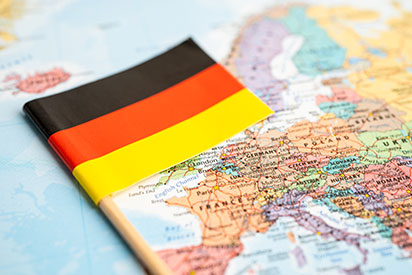
Germany is located in northern Central Europe and covers an area of about 356,750 square kilometers and shares a border with nine other European countries, including Austria, Belgium, the Czech Republic, Denmark, France, Luxembourg, the Netherlands, Poland and Switzerland, and is strategically in the middle of one of the world’s most active trade zones.
About Germany has easy access to Nordic countries and the UK in terms of geographical location. The capital is Berlin, the largest city in Germany and one of the most influential centers in European politics and culture, with a population of more than 80 million people, the largest economy in Europe and one of the largest economies in the world. The country is one of the three largest exporters in the world, and in Germany the official language of the German country, which is also spoken in many other countries such as Austria, Switzerland and some Eastern European countries, and therefore the German language is one of the ten most common languages spoken in the world. And the weather and temperatures vary according to region and season, however the country usually experiences all four seasons of the year, and especially in the south, winters are cold and with a lot of snow and hot and hearty summers.
Today, Germany is divided into 16 states:
- Baden-Württemberg
- Bayern
- Berlin
- Brandenburg
- Bremen
- Hamburg
- Hessen
- Mecklenburg
- Vorpommern
- Niedersachsen
- Nordrhein-Westfalen
- Rheinland-Pfalz
- Saarland
- Sachsen
- Sachsen-Anhalt
- Schleswig-Holstein
- Thüringen
Germany is divided into more than 400 regions and cities, and the country’s history has gone through a long and rugged path of war and occupation. In recent years, German-speaking countries in Europe have faced demographic changes due to decades of migration. Non-ethnic Germans currently make up nearly 10 percent of Germany’s population, most of them descendants of guest workers who arrived in the 1960s and 1970s. Almost one in five foreigners living in Germany were born abroad and therefore a second or third immigrant. A third of Turkish, Italian and Greek citizens living in Germany were born there. In addition, a significant number of German citizens, although traditionally German, are born to foreign immigrants who often maintain their country’s cultural and linguistic identity in addition to the German language. Immigrants are always encouraged to participate in all areas of society by learning German and basic laws and respecting them, and the state and local federal governments are all responsible for ensuring this.
In Germany, primary education is compulsory for children, and the country has one of the highest levels of education and the status of many of the world’s most famous universities.
Philosophy and educational ideas in Germany differ significantly from other countries. The emphasis is on socialization, discussion, participation and criticism of the principles of education in Germany. After 10th grade (usually at the age of 16), German students can choose industrial education instead of pursuing higher education. This vocational training is called the Duales Ausbildungssyste system and includes studying at a company as well as attending a vocational school (Berufsschul) where a student is learning for a three-year course. Practical parts of a job are taught in the company, while theoretical sections are taught in vocational schools. After three years, exams are held at the Chamber of Commerce and Industry, after which companies routinely employ graduates in their own company.
German citizens can choose the type of education they want and access the persons or professions they want. The purpose of this educational policy in Germany is to provide every citizen with personal, professional and citizenship growth opportunities based on their abilities and preferences, and 16 German states provide educational and higher education opportunities for everyone through a variety of educational institutions and educational programs.
Germany is the largest EU country located at the heart of the continent and is therefore an important transport hub for routes north/south and east/west. When starting a business in Germany, it is essential to be aware of all relevant distribution channels, shipping options and accommodation options that will be available to you and your business.
Major German cities have an integrated transport system including a fast rail network (S-Bahn) tram (Straßenbahn) and in many cases an underground system (U-Bahn). All of these means of transport reach a detailed timeline, and remote areas deal well with rail and tram services using bus connections.
Germany’s national railway network, mostly run by Deutsche Bahn, is more than 36,000 kilometers long. Germany also has a good road network. There are no speed limits on the highways except for some, and along the highway you can access many refueling stations, motels and kiosks that are open at all hours. More than 100 international airlines also fly in Germany and abroad. The Global Routes Network connects 18 international airports in Germany with more than 800 destinations worldwide. The largest airports are in Frankfurt, Munich and Düsseldorf, and all airports have major connections to the local and regional transport network.
You will need information about this to start up and activate your start-up company in Germany. Years of working as a consultant in industrial purchasing have given me the opportunity to gain experience from the different situations I have been in ahead. Learn more about this by clicking on the link below.
You will need information about this to start up and activate your start-up company in Germany. Years of working as a consultant in industrial purchasing have given me the opportunity to gain experience from the different situations I have been in ahead.
There is no real taboo in Germany to apply in other Western countries. Northern Germany is relaxed about etiquette towards southern Germany. Germans are very direct and honest. If they can or want to help you, they will, otherwise they will tell you. Understanding these issues will contribute significantly to understanding German culture and building and maintaining strong and solid business relationships.